
The Certainty Principle
An evidence-based pathway to better data center investment decisions.
In a compute-constrained world, companies and governments face immense pressure to invest in more capacity, fast. Yet most of those decisions rest on incomplete data. That certainty gap is driving overspend, unnecessary operational and financial risk, and avoidable CO₂ emissions.
Know exactly what your existing estate can deliver before you make your next investment decision.
In quantum physics, Heisenberg’s Uncertainty Principle is a law of nature. In data centers, uncertainty is simply a gap in the evidence. EkkoSense closes that gap.
That is the Certainty Principle.

Daniel Kline CEO, EkkoSense

Executive Summary
New build, expansion, retrofit, upgrade or lease: whatever your next data center decision, it will be made under pressure. If you were asked today to prove how much usable capacity your existing data centers have, could you? If not, how can you be sure you’re not paying for capacity you already own?
Organizations are making major capital expenditure decisions based on incomplete data. It’s not that they ignore the evidence. The evidence itself has gaps. It’s pieced together from nameplate ratings, design assumptions, periodic audits and systems that were never designed to talk to each other. That uncertainty gets priced into every decision as safety margin. Across large estates, that margin could be driving billions of dollars of over-provisioning.
This is not a hypothesis. It is what our data shows, and the cost is measurable. The figures in this paper come from EkkoSense’s own data and experience: more than 10 years of highly-calibrated optimization, more than 100,000 racks in over 50 countries, and over 100 billion data points. That performance data covers virtually every piece of hardware and software deployed in air-cooled, hybrid air-and-liquid and fully liquid-cooled data centers, making it the deepest and widest data set of its kind in the market. It shows organizations leaving money on the table, emitting more CO₂ than they need to, and taking on unnecessary risk and spend before they have fully optimized and realized their existing data center capacity and potential.
Based on our deep and wide data set, the central issue facing the market is clear: certainty, knowing what an estate can deliver safely. Optimization is what that certainty unlocks.
That matters across the leadership team. The CFO allocating capital, the CEO accountable for growth and shareholder value, the Chief Sustainability Officer committed to emissions targets, Procurement negotiating capacity, leases and equipment, and the CIO responsible for resilient compute all depend on the same answer. Before they commit capital, they and the board need credible answers to four questions:

The operators running these estates are not the problem. Uptime matters, and when the evidence is incomplete, running conservatively is the rational choice. But uncertainty creates safety margin, and safety margin creates stranded capacity and cost. Across a large, global estate, the specialist expertise needed to interpret fragmented data and judge where that margin can safely be released is scarce. And that expertise certainly does not scale at the rate today’s data center estates are growing.
Establishing your foundational Operational Truth
That’s the gap EkkoSense closes with Operational Truth: a continuously updated, evidence-based view of what your estate can safely deliver, what’s holding it back, and how much usable power, cooling and space capacity remains. Our expert optimization software is secure by design, supports the most complex deployments and, as a globally-trusted partner for this data, EkkoSense gives small, skilled teams evidence they can trust to make better, more consistent decisions across many sites – unlocking extra capacity and performance without adding risk.
Across EkkoSense’s data, the pattern is consistent in new and legacy estates alike: 5–35% of cooling energy wasted and 5–30% of rack capacity stranded. Energy savings are the most tangible return, building a particularly strong ROI case, however recovered capacity is worth more. The biggest prize is better capital decisions: whether, when and how much to build, and whether the next investment can be resized, deferred or avoided.
With that evidence in hand, optimization becomes the smart option: it uses facilities already paid for, needs no construction, delivers results in weeks and reduces risk. Every megawatt recovered needs no new concrete, steel, grid connection or water, so the financially responsible decision and the sustainable decision become one and the same.
The case does not depend on whether AI is a bubble. If demand keeps accelerating, getting more from installed assets is sensible; if it slows, avoiding premature commitments is sensible. Either way, certainty protects margins, reduces risk, supports sustainability goals, and creates and safeguards shareholder value.

1. The proposal on the table
Picture the moment this paper is about. A business case for more capacity has been made. The investment proposal is in front of the board, and the board is being asked to sign.
The sums are large. Moody’s expects the largest hyperscalers and AI cloud providers to spend about $785 billion on capex in 2026, approaching $1 trillion in 2027. Enterprises and governments are following with their own programs. Yet even the most sophisticated buyers of capacity are learning that plans must be continually tested against reality.
- Microsoft, 2025. Analysts at TD Cowen reported that Microsoft cancelled or deferred up to 2 GW of planned data center capacity in the US and Europe, while still planning around $80 billion of AI data center spend that year. Microsoft said it may “strategically pace or adjust” its infrastructure. If a hyperscaler keeps reassessing where and how much capacity it needs, every board should.
- Thailand, September 2026. Thailand’s government asked developers to pause construction on 49 data center projects and froze approvals for 117 more, more than the roughly 35 data centers operating in the country, amid concern over power and water use. Because many facilities had been permitted as warehouses, no single authority even kept a reliable count of them. A government asking, “do we need 166 more data centers?” faces the same question as a board asking, “do we need this new campus?” Both need trusted operational evidence of what existing capacity delivers today.
- Microsoft and Nscale, October 2026. Microsoft terminated its contract for Nscale’s planned AI facility at Loughton in Essex, designed for 50 MW and scalable to 90 MW with 23,040 NVIDIA GB300 GPUs. The reason was power: the local network operator warned the site might not get sufficient grid capacity until the early to mid-2030s, years after its planned 2027 opening. As one analyst observed, a facility that cannot be powered earns no revenue, while its construction and financing costs keep running.
The lesson is not that building is wrong. It is that new capacity carries timing, power and delivery risks that existing capacity does not. Grid connections in major US markets now take more than four years on average, and around seven in Northern Virginia. In the UK, grid connection requests rose from 41 GW to 125 GW in under a year, at least 80 GW of it from data centers.
Against that backdrop, capacity that can be safely released inside facilities already built, powered and paid for is the fastest and lowest-risk capacity available. The question is whether the board can see it.
2. Expertise does not scale at the rate estates grow
The real constraint on most data center estates isn’t the equipment or the data. It’s the scarce expertise needed to turn that data into confident, consistent decisions across many sites.
Plenty of data, not enough certainty
Every data center already generates data. Building Management Systems (BMS), Electrical Power Monitoring Systems (EPMS), Supervisory Control and Data Acquisition (SCADA), Data Center Infrastructure Management (DCIM), asset registers, IT tools and finance systems each hold part of the picture. But they were bought at different times, from different vendors, for different teams, and were never designed to talk to each other.
Somebody still has to interpret that fragmented information and apply sound engineering judgement: where the thermal headroom really is, which racks can safely take more load, which cooling units are working hardest for no reason. In a single site, a strong engineer can do that. Across dozens of sites on several continents, with talent scarce and turnover high, it cannot be done consistently by hand. Uptime Institute’s 2026 survey found more than half of operators struggle to find qualified staff.
Why caution is rational, and why it is expensive
Facilities teams are not running these estates badly. When uptime matters and the evidence is incomplete, conservative operation is exactly the right thing to do. But that caution has a chain of consequences that rarely reaches the board:

Better evidence breaks that chain. It lets the same skilled people release margin where it is safe to do so, and keep it where it is not, without asking anyone to accept more risk.
Operational Truth: scaling the judgement, not just the data
In practice, Operational Truth brings thermal, power, cooling, capacity and space data together at rack level across the whole estate, keeps it current, and turns it into prioritized, evidence-based recommendations. It sits above existing BMS and control systems rather than replacing them, and people stay responsible for every decision. A relatively small team can then make better, more consistent decisions across a far larger, globally distributed estate.
3. Four questions before you sign
If a board cannot answer these four questions with credible operational evidence, it may not yet be ready to approve the next major investment.

These questions take the conversation well beyond cooling and energy. They’re about asset utilization, risk and capital allocation, which are the issues boards own. Answered with evidence, they let the board resize, defer or even avoid an investment, or approve it knowing it’s really needed.
4. The evidence: what we find
When estates are measured properly the gap between assumed and actual capacity is large, in new facilities as well as legacy ones.
Across EkkoSense’s data set of more than 100,000 racks in over 50 countries, the pattern is consistent:
- 5–35% of cooling energy wasted on over-cooled rooms. This is the visible cost of safety margin, running rooms cold because nobody can see the actual performance with confidence. EkkoSense research across 128 UK data centers and 16,500 racks found 78% of facilities faced varying levels of thermal non-compliance where over and undercooled spaces co-exist.
- 5–30% of rack capacity stranded: power, cooling or space that has been paid for but cannot be used with confidence because the true headroom has not been proven.
Results in live estates

5. Certainty makes optimization the smart choice
Certainty and optimization are not alternatives. Certainty is what makes optimization safe, fast and repeatable.
Once operators can see exactly where margin is unnecessary, removing it is one of the clearest financial and sustainability decisions a business can make.

With clear evidence, the case for optimization makes itself, and it is the first step towards the bigger prizes of released capacity and better capital decisions.
6. Where the value lies: energy, capacity, capital
The value of certainty builds in three layers. Each is larger than the last.

Energy is the most tangible return, and the one EkkoSense has the deepest evidence for. Capacity is worth more, because each megawatt released is capacity the organization does not have to build or lease. But the biggest board-level prize is better capital decisions: do we really need the next facility or upgrade, when do we need it, and could existing constraints be removed more quickly and cheaply?
Certainty does not always mean spending less. Sometimes the evidence will show that a new facility is needed sooner or larger than planned. The value lies in making that call from measured operational evidence. With that evidence, a board can resize an investment, defer it, avoid it where justified, or approve it with confidence.
An illustrative 50 MW estate
The example below uses simple assumptions a finance team can replace with its own.

Shareholder value, risk and sustainability
The same evidence serves every part of the board’s agenda:
- Shareholder value: a higher return on assets already on the balance sheet, and capital deployed only where it earns its keep.
- Governance: investment decisions that can be defended to auditors, investors and regulators with measured data.
- Sustainability: lower emissions and avoided construction (see section 7).
- Risk: real-time anomaly detection and predictive maintenance that flag problems before they become outages; fewer hidden hot spots and capacity surprises; and less exposure to grid, permitting and delivery delays on new builds.
7. Financially responsible and sustainable: the same decision
Certainty is where financial discipline and sustainability meet. The actions that protect the balance sheet are the same ones that cut emissions.

The most financially responsible megawatt and the most sustainable megawatt are the same one: the one you already have.
8. The case holds either way
There is a lively debate about whether today’s AI investment wave is a durable boom or the start of another infrastructure overbuild. The argument for certainty does not depend on the answer.

This is not a bet on the cycle. It is good practice. No well-run business would build a new factory without first knowing what the ones it owns can produce. Data centers deserve the same discipline, and the same certainty.
9. Before you sign
The answer is not to stop investing. It is to make sure every investment decision rests on evidence of what the existing estate can safely deliver.
- Establish certainty. Put a single, trusted Operational Truth across every facility, so finance, risk, sustainability and operations work from the same measured picture.
- Answer the four questions. For every major capacity proposal, require measured answers on usable capacity, constraints, the cost of removing them, and how that compares with building.
- Release what is safe to release. Remove unnecessary margin where the evidence supports it, keep it where it does not, and track the result in energy saved, capacity released and capital resized or deferred.
- Govern it. Make usable capacity, stranded capacity and cost per unit of compute standing board metrics, reviewed alongside every new investment.
What this means for each leader
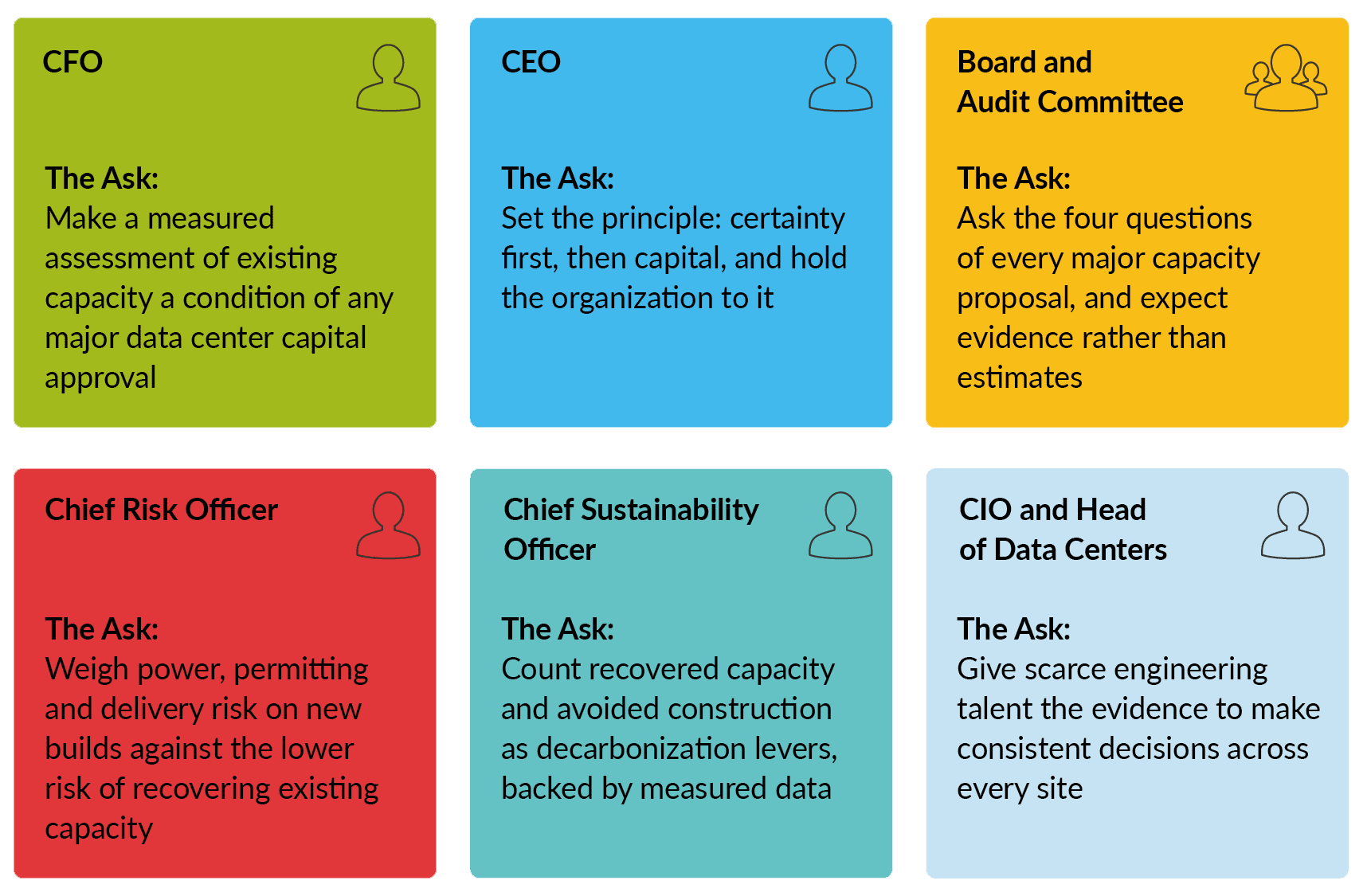
The bottom line
The next data center may well be needed. But it should be approved because the evidence says so, not because nobody could prove otherwise. Before you sign, know what you already have. That certainty pays a dividend: lower cost, lower risk, lower emissions, better use of capital, and value created and protected for shareholders.
Sources
- Daniel Kline, “Data Center Operations Intelligence Platform: Moving beyond visibility to turn data overload into decision advantage”, EkkoSense white paper, 2026 (Operational Truth framework; Everest Digital, Telefónica Germany, Telehouse and global bank results)
- Moody’s hyperscaler capex forecasts marked up by $85bn to close in on $1trn by 2027, DCD, May 2026
- Microsoft cancels up to 2GW of data center projects, says TD Cowen, DCD, March 2025
- Thailand pauses construction on 49 data centers as it plans new regulations, DCD, September 2026
- Thailand halted more data centers than it has running, The Next Web, September 2026
- Microsoft abandons UK AI supercomputer as grid struggles to keep up, The Register, 19 October 2026
- Nscale loses Microsoft deal as power delays threaten AI, Data Center Knowledge, 19 October 2026
- Why are data centers waiting years for a grid connection?, Spencer Ogden, citing JLL 2026 Global Data Center Outlook
- Uptime Institute 16th annual Global Data Center Survey 2026, July 2026
- UK data centers fail to meet ASHRAE thermal guidelines, DCD, on EkkoSense research
- Virgin Media O2 works with EkkoSense to unlock data center cooling energy savings worth over £1 million per year, September 2024
- 50Cooling waste (5–35%) and stranded capacity (5–30%) ranges: EkkoSense data set (10+ years, 100,000+ racks, 50+ countries, 100+ billion data points)
- 50 MW example: illustrative assumptions, not a forecast
Download this article as a pdf eBook here.
CEO, EkkoSense

