
The Complete Guide to Data Center Power Monitoring


Bernard Tan, Vice President of Sales, Asia Pacific Japan
Key Takeaways: The Complete Guide to Data Center Power Monitoring
- Power-related failures account for 54% of impactful data center outages, making monitoring a non-negotiable operational priority.
- Monitoring blind spots emerge from misconfigured thresholds, siloed tools, and static alerting that fails to reflect live conditions.
- Real-time power visibility at the rack, row, and room level helps operators detect hidden capacity risks before they cause downtime.
- EkkoSense EkkoSoft Critical correlates power data from UPS, PDU, and branch circuits into a single orchestration layer for capacity decisions.
- Effective alerting requires context-aware rules calibrated to actual load behaviour, not blanket static thresholds.
Why Data Center Power Monitoring Matters More Than Ever
Power demand across the data center estate is accelerating. AI and high-performance compute workloads are pushing rack densities beyond what many facilities were originally designed to support. The mechanical and electrical infrastructure has to keep up, and visibility into real-time power draw is the first line of defence against unplanned downtime.
The Uptime Institute’s 2025 Annual Outage Analysis found that power remains the dominant cause of impactful outages, responsible for 54% of cases. And when outages do occur, 54% cost more than $100,000, with 20% exceeding $1 million. For operators managing critical workloads, an undetected power anomaly can move from minor irregularity to full-scale service disruption in minutes.
This constraint plays out from edge to enterprise, colocation provider to hyperscaler. Every operator shares the same fundamental pressure: rising density and demand, paired with ageing electrical infrastructure that was never instrumented for this level of scrutiny.
What Is Data Center Power Monitoring?
Data center power monitoring is the continuous measurement and analysis of electrical consumption across IT and facility infrastructure. The goal isn’t to collect data for its own sake. It’s to support capacity planning, ensure resilience, and give operations teams the signal they need to act before a fault escalates.
A well-instrumented power monitoring strategy measures at multiple layers: the utility feed, generator, UPS, switchgear, PDU, branch circuit, and individual rack. Each layer reveals different operational signals. Missing any one of them creates a gap that operators are often forced to bridge with conservative assumptions and over-provisioned safety margins.
EkkoSense EkkoSoft Critical applies real-time analytics to transform raw power data into actionable operational intelligence, correlating UPS systems, PDUs, and branch circuits into a unified view of consumption and capacity at every level of the power chain.
How Power Monitoring Blind Spots Create Hidden Capacity Risks
Siloed Monitoring Tools and Fragmented Data
Most data center estates run several generations of BMS systems, energy monitoring platforms, and point tools that were never designed to work together. The data exists across disconnected dashboards and spreadsheets, spread across systems that don’t share a common data model or timestamp.
When power data is fragmented this way, no single team has a clear picture of how close the estate is to its actual limits. The risk isn’t always a sudden spike. It’s the slow drift toward a threshold nobody can see because the relevant signals are scattered across three different systems.
Misconfigured Thresholds and Alert Fatigue
Static thresholds set at commissioning often don’t reflect today’s load profiles. A 70% PDU utilisation alarm that made sense five years ago may now fire dozens of times a day as AI workloads create intermittent spikes that peak and settle rapidly.
The consequence is alert fatigue. When every alarm looks the same, operators stop responding to the ones that actually signal emerging risk. Weak alerting doesn’t just miss faults. It trains teams to ignore the monitoring system entirely, creating a dangerous operational gap between what the system detects and what operators act upon.
Stranded Capacity Hidden by Aggregated Data
Estate-level or room-level averages mask what’s happening at the rack. A room running at 60% average power draw might still contain individual racks at 90%+ utilisation and adjacent racks at 25%. Without granular, rack-level visibility, operators either overcommit (risking outages) or under commit (leaving money on the table in stranded capacity that could be sold or repurposed).

The Five Critical Layers of Data Center Power Monitoring
Layer 1: Utility and Generator Feed
Monitoring at the point of supply captures incoming voltage quality, frequency, and power factor. Fluctuations here can cascade through the entire power chain. This layer is where grid-level constraints (brownouts, harmonic distortion, frequency dips) first appear and where resilience planning begins.
Layer 2: UPS Systems
UPS monitoring tracks battery health, load balance across modules, and transfer switch state. A UPS operating at high load with degraded batteries is an outage waiting to happen, but it only shows up as a risk if you’re watching in real time rather than relying on periodic maintenance checks.
Layer 3: Switchgear and Distribution Boards
Switchgear monitoring captures bus capacity utilisation and fault current availability. For operators planning new deployments, this is where capacity ceilings become visible before they become problems. Many outages trace back to overloaded distribution boards that nobody was actively tracking.
Layer 4: PDU and Branch Circuit
PDU-level monitoring is where most capacity planning decisions actually get made. Tracking per-circuit load, phase balance, and peak draw over time gives operators the data to make informed deployment decisions rather than relying on estimates. EkkoSense capacity planning capabilities track PDU utilisation in real time, supporting multiple UPS systems and up to eight PDUs per rack for the largest environments.
Layer 5: Rack-Level and IT Load
This is the most granular layer and the one most often neglected. Rack-level power data reveals which cabinets are approaching their design limits, and which hold untapped capacity. Without it, every deployment decision involves guesswork that compounds risk over time.
Why Traditional Monitoring Approaches Hit a Wall
The monitoring tools installed in most data centres were designed for a different era. They report average utilisation over 15-minute intervals, capture snapshots rather than streams, and present data in flat dashboards that require a human to spot the anomaly manually.
That approach was adequate when load profiles were stable and rack densities were predictable. It isn’t adequate when a single GPU cluster can consume 60kW per rack and spike load by 40% in seconds during training cycles.
The constraint isn’t that operators lack data. It’s that the data arrives too late, too aggregated, and in too many disconnected places for any team to act on it in the window that matters. This is where the shift from monitoring-as-reporting to monitoring-as-decision-support becomes a strategic imperative for the entire industry.
Effective Alerting: Moving Beyond Static Thresholds
Context-Aware Alert Configuration
Effective alerting requires rules calibrated to actual operating behaviour, not blanket thresholds set at commissioning. A circuit feeding GPU infrastructure running sustained 85% load is operating normally. The same reading on a circuit feeding storage arrays may signal an imminent trip.
Context means understanding what’s normal for a specific circuit, at a specific time, under specific load conditions. EkkoSense alerting capabilities support item-level thresholds that adapt to individual equipment behaviour, reducing noise and surfacing the signals that represent genuine risk.
Anomaly Detection and Early Warning
Machine learning applied to historical power data can identify deviations from expected patterns before they reach alarm thresholds. A gradual upward drift in baseline draw on a branch circuit might indicate a failing PSU or an unplanned load addition. Catching it early means a planned intervention rather than an emergency response at 2am. EkkoSense uses machine learning for proactive alerts, currently drawing on historical patterns to flag cooling anomalies that static thresholds would miss entirely. Going forward, TeamEkko is working on adding the ability to track power anomalies to its software.
Escalation and Integration with Operational Workflows
Alerts that don’t reach the right person in the right timeframe have no operational value. Integration with ITSM platforms, NOC dashboards, and mobile notifications ensures that critical power alerts reach decision-makers before the window for preventive action closes. The gap between detection and response is where outages live.

Power Monitoring for Capacity Risk Detection
Identifying Approaching Capacity Ceilings
Capacity risk doesn’t announce itself with a single dramatic event. It builds over weeks and months as incremental load additions consume headroom nobody realised was shrinking. Effective power monitoring identifies this trajectory and alerts operators when utilisation crosses defined planning thresholds, giving teams time to respond strategically.
Phase Imbalance and Hidden Overloading
Three-phase power systems in data centres are rarely perfectly balanced. Transient workloads and mixed equipment types create asymmetric loading that can push one phase toward its limit while the other two operate with headroom. Monitoring phase balance at the PDU and branch circuit level reveals this hidden overloading before it causes a breaker trip.
EkkoSoft Critical automates power breakdown analysis across rooms, splitting BMS data into IT loads, cooling loads, and non-IT usage to give operators a granular understanding of where power is consumed and where imbalances exist.
Planning for AI and High-Density Workloads
AI compute environments present a fundamentally different power profile. Training workloads spike and plateau in unpredictable patterns. Inference workloads create sustained high-density draw. Both require monitoring granularity that few legacy tools can deliver at the speed and resolution needed for safe operations. Operators deploying AI infrastructure need real-time visibility into how these new workloads interact with existing power distribution. Without it, every density decision carries unquantified risk that accumulates across the estate.
Connecting Power Monitoring to Outage Prevention
The 2025 Uptime Institute data shows that 80% of operators believe better management and processes would have prevented their most recent significant outage. The data also reveals that human error (specifically, staff failing to follow procedures) increased by 10 percentage points compared to 2024.
These two findings are connected. When operators lack real-time visibility into power conditions, they’re forced to make decisions based on stale data and memory. That’s where procedures get skipped: not through negligence, but because the data needed to follow them safely isn’t available at the point of decision.
Real-time data center operational visibility closes this gap. When engineers can see live power draw, historical trends, and capacity headroom in a single view, following safe operating procedures becomes the natural path rather than the burdensome one.

How to Implement a Power Monitoring Strategy
Step 1: Audit Your Current Instrumentation
Map every point in the power chain where measurement currently exists. Identify gaps between what’s monitored and what’s actually needed for capacity decisions. Most estates discover significant blind spots at the branch circuit and rack level once they conduct a proper instrumentation audit.
Step 2: Define Monitoring Objectives by Layer
Different layers of the power chain serve different operational purposes. Utility-level monitoring supports resilience planning. PDU-level monitoring supports deployment decisions. Rack-level monitoring supports capacity release. Define what each layer needs to deliver before selecting instrumentation.
Step 3: Deploy Granular Sensing
Close the identified gaps with appropriate sensing. Modern approaches use low-cost wireless sensors and software-based integration with existing BMS and PDU infrastructure to avoid disruptive installation requirements. EkkoSense deploys light-touch wireless sensors alongside software integration with existing telemetry to build granular power visibility without rip-and-replace.
Step 4: Establish Baseline Behaviour
Before meaningful alerting can function, the system needs a baseline of normal operating behaviour for each monitored point. This involves collecting several weeks of operational data to establish typical load patterns, peak periods, and seasonal variation across each circuit and rack.
Step 5: Configure Contextual Alerting
Set alert thresholds based on the established baselines and operational risk tolerance, not manufacturer defaults. Configure different thresholds for different equipment types, times of day, and load profiles. Review and recalibrate quarterly as workloads evolve and new equipment deploys.
Step 6: Integrate with Capacity Planning Workflows
Connect real-time power monitoring data into capacity planning workflows so that deployment decisions reflect current conditions rather than last month’s spreadsheet. This integration is where power monitoring stops being a reporting exercise and becomes an operational decision-support capability.
The Role of Power Monitoring in ESG and Regulatory Compliance
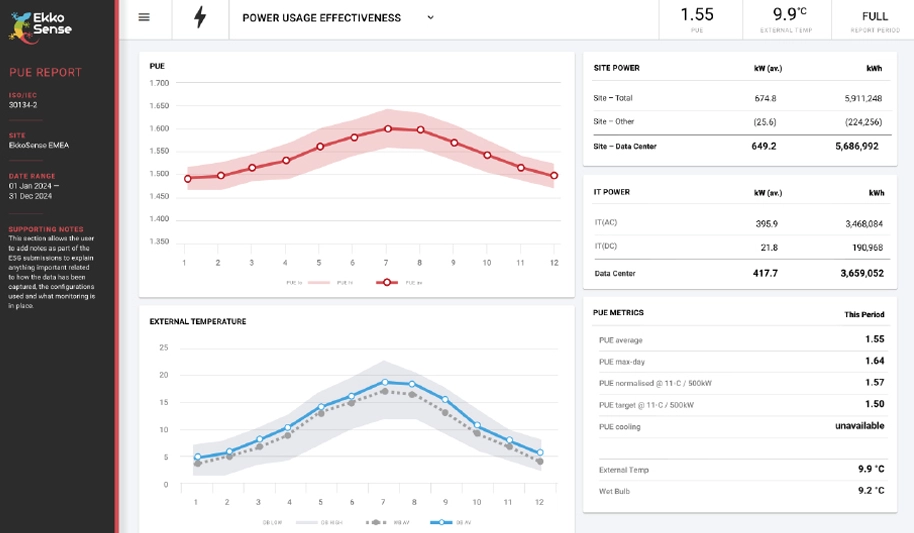
Power monitoring data feeds directly into PUE calculations, carbon reporting, and regulatory compliance under frameworks such as CSRD, EED, and SB 253. Without accurate, real-time power data split into IT and non-IT consumption, these reporting obligations require manual data gathering that’s both time-consuming and error-prone.
EkkoSense automated ESG reporting draws on real-time power monitoring data to produce audit-ready reports that separate IT load from cooling and facility overhead, removing the manual burden from operations teams while ensuring data accuracy for regulators.
As regulatory requirements tighten and stakeholders demand verifiable sustainability data, the quality of power monitoring instrumentation becomes a compliance constraint, not just an operational one.
Building a Power Monitoring Architecture for the Next Decade
Estates that were instrumented for 5-10kW per rack cannot support decision-making at 40-60kW per rack without fundamental changes to monitoring granularity. Building a power monitoring architecture for the next decade means investing in:
- Rack-level sensing that captures real-time draw rather than periodic snapshots
- Software that correlates power data with thermal and capacity data in a single platform
- Alerting that learns from operational patterns rather than relying on static thresholds
- Integration points that feed monitoring data directly into capacity planning and ESG reporting workflows
- Support for hybrid power distribution architectures serving both air-cooled and liquid-cooled infrastructure
EkkoSense EkkoSoft Critical addresses these requirements through its unified orchestration layer, correlating power, thermal, and capacity data from across the estate into a single real-time view accessible from any browser, anywhere.
In Conclusion: How to Gain Real-Time Power Visibility for Safer Capacity Decisions
The constraint facing data center operators isn’t the absence of monitoring technology. It’s the gap between what monitoring systems report and what operations teams need to make safe, confident capacity decisions in real time.
Closing that gap requires granular instrumentation, context-aware alerting, and software that turns fragmented power data into a unified picture of risk and opportunity across the entire estate. The operators who invest in this visibility now will be the ones who can safely absorb the density increases, regulatory demands, and reliability expectations that are already arriving.
The underlying ambition doesn’t change: as much compute as possible, from as little resource as possible, with zero unplanned downtime. Power monitoring is how you make that ambition operationally safe. Contact EkkoSense to continue the conversation about your data center power monitoring requirements.
FAQs About Data Center Power Monitoring
What is data center power monitoring and why is it critical?
Data center power monitoring is the real-time measurement of electrical consumption across IT and facility infrastructure to support capacity planning, outage prevention, and efficiency. It’s critical because power failures cause 54% of impactful outages, according to the Uptime Institute’s 2025 Annual Outage Analysis.
How does EkkoSense help with hidden power capacity risks?
EkkoSense EkkoSoft Critical correlates power data from UPS, PDU, and branch circuit levels into a unified real-time view. This granular visibility reveals stranded capacity and approaching ceilings that aggregated monitoring tools miss, helping operators make informed deployment decisions confidently.
What causes power monitoring blind spots in data centres?
Blind spots typically emerge from siloed monitoring tools that don’t share data, misconfigured alert thresholds set during commissioning and never updated, and reliance on room-level averages rather than rack-level measurement. Each gap creates hidden risk that only becomes visible during a fault event.
What should a power monitoring strategy include for AI workloads?
AI workloads demand rack-level power monitoring with sub-minute granularity because training cycles create rapid, high-amplitude spikes that averaged data hides. EkkoSense supports monitoring across hybrid air, liquid, and immersion cooling architectures, giving operators real-time visibility into how AI power profiles interact with existing distribution limits.
Next steps? Contact the author Bernard Tan who is VP for EkkoSense AI in AP-J. If you are based in the Americas, please contact Bernard’s colleague Steve Lewis – or for EMEA Matthew Farnell.